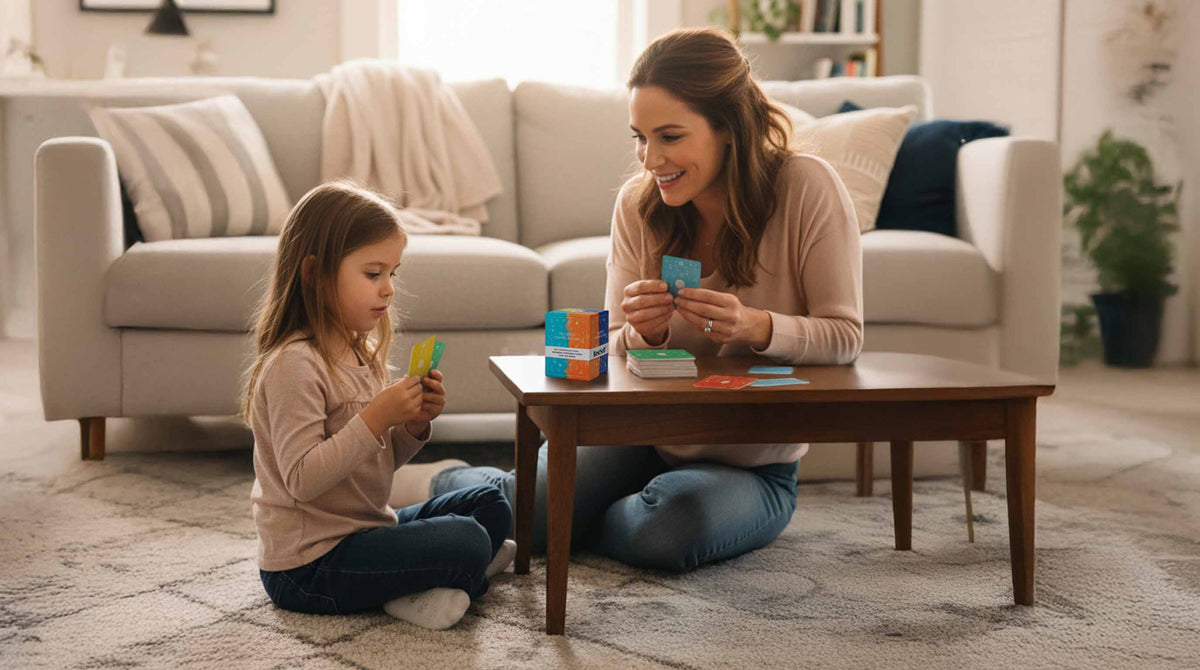
Somewhere between the car door and the kitchen, "How was school?" turns into "Fine," and that's the whole conversation. Then you ask what they did today and get "nothing."
Here's the thing: one-word answers usually say more about the question than about the kid. This is for parents, grandparents, and anyone with kids in their life who wants to get past "fine," with better questions, better moments to ask them, and small rituals your family will stick with. There's a printable 14-day plan and a one-page cheat sheet along the way, too.
What's inside
57 questions
Sorted by age
8 family rituals
Simple and repeatable
14-day plan
One small step a day
A restart plan
For eye rolls and off weeks
Is this you?
"How was school?" "Fine." Sound familiar?
You want to know how they really are. You ask, they shrug, and the conversation ends before it starts. One-word answers happen at every age. Usually the question is too big, the timing is off, or it feels like a quiz, and all three are easy to fix.
12%
of people in our community named missing moments with their children as a top worry about phone time.
From our community survey
"Being present for my kids when they want to play with me."
★ Customer review
"With a 4yo, half the time you get one-liner dead-ends."
Based on a BestSelf community survey of about 430 people.
★ Customer review
"So fun getting to know my kids on a different level."
How to use this guide
1
Read Steps 1 to 3.
About 15 minutes. They work at every age.
Start here
Who are you talking to?
Pick the ages in your life. Each group has its own set of questions.
Then check what gets in the way most
- I get one-word answers, or "I don't know." → Step 1
- By the time we're together, everyone's on a screen. → Step 2
- We never seem to find the right moment. → Step 2
- They start talking, and I'm not sure what to say back. → Step 3
- We don't really have family routines. → Step 4
- I want something simple to follow, day by day. → 14-day plan
Step 1 · Better questions
Swap the quiz for a conversation
Big, vague questions like "How was your day?" ask a child to summarize, and summarizing is work. Small, specific, slightly fun questions are easy to answer, and easy answers lead to longer ones.
Instead of this, try this
Instead of
How was school?
Try
What was the best part of your day? And the most boring?
Instead of
Did you have fun?
Try
What made you laugh today?
Instead of
Who did you play with?
Try
Who would you want to sit next to tomorrow? Why?
Instead of
How was practice?
Try
What's one thing the coach said that stuck with you?
Instead of
Is everything okay?
Try
On a scale from pizza to broccoli, how was today?
Instead of
What did you learn?
Try
What's something you learned that surprised you?
- Small. Ask about one moment, rather than the whole day.
- Specific. Mention a person, a class or a game they care about.
- You go too. Answer your own question. It turns a quiz into a conversation.
Step 2 · The right moment
Timing matters as much as the question
Kids open up when they feel relaxed and unwatched. The same question can get a shrug at the front door and a ten-minute story in the car. Find the moments when talking comes easy in your family.
Car rides
No eye contact and a built-in end time. Many kids talk more in the car.
The dinner table
Phones in a basket. One question, and everyone answers.
Bedtime
Lights low, day winding down. Little kids and tweens often open up here.
Side by side
Cooking, walking the dog, shooting hoops. Great for teens.
After a breather
Give them 20 minutes after school before asking anything.
Holidays and gatherings
Questions in a jar on the table get every age talking.

Featured product
If your phone is the one that keeps sneaking out of the basket, Helm can help. It blocks distracting apps and limits screen time, which makes it a lot easier to be the grown-up who goes phone-free first.
Take a look →Questions · Little kids (3 to 7)
Questions for little kids
Keep it playful. Little kids answer best when a question feels like a game.
- What made you laugh today?
- If you were an animal today, which one would you be?
- What was the yummiest thing you ate today?
- Who did you help today? Who helped you?
- If your toys could talk, what would they say about you?
- What can you do now that you couldn't do when you were little?
- What would you build with a giant box?
- What made you feel brave today?
- If we had a magic day with no rules, what would we do first?
- What's your favorite thing about our family?
- What color was your day? Why that color?
- What do you want to dream about tonight?
- If you were a grown-up for a day, what job would you try?
- Did anything make you feel sad today?
- What should we do together this weekend?
- Give choices. "Was today more like a sunny day or a rainy day?"
- Answer first. They'll copy the shape of your answer.
- Accept silly. A silly answer still means they're talking.

Featured product
Little kids love being the one who asks. Hand them the Little Talk Deck at dinner and let them pull the next question for everyone at the table.
Take a look →Questions · Big kids (8 to 12)
Questions for big kids
Big kids love having opinions. Ask what they think, and take the answer seriously.
- What's the most interesting thing you learned this week?
- Who in your class would you want with you on a desert island?
- If you ran the school for a day, what would you change?
- What are you getting better at?
- What game, show or video is everyone talking about? Explain it to me.
- When did you feel proud of yourself lately?
- What's something that's harder than it looks?
- Would you rather fly or be invisible? Why?
- What's a rule you think is unfair?
- What's something about you most people don't know?
- If you could invent anything, what would it be?
- What's a friend doing that you think is really cool?
- Is anything worrying you, even a little?
- What do you want to learn how to do this year?
- What's your favorite memory of us together?
- Let them teach you. Asking them to explain their world shows you respect it.
- Hold the lecture. If they share a mistake, thank them first.
- Follow their lead. A tangent is a good sign.
Questions · Teens (13 to 18)
Questions for teens
Teens talk when it feels like a real conversation between two people. Ask, listen, and let it be short if it's short.
- What are you into right now that I probably don't know about?
- What's the best thing about being your age? The hardest?
- What's a song I should listen to?
- What do adults get wrong about people your age?
- Who do you admire, and why?
- What have you changed your mind about this year?
- If you could live anywhere for a year, where would it be?
- What skill would you like to learn that school doesn't teach?
- Is there a decision you're thinking about right now?
- What makes a good friend?
- What do you wish I asked you about more?
- What small thing makes a bad day better?
- What are you proud of that you haven't told me?
- What would your perfect weekend look like?
- What do you want to remember about this year?
- Side by side. Ask in the car or while cooking, not across a table.
- Accept "I don't know." Try again another day. The door stays open.
- Share your teen years. Your stories make it safe to share theirs.
Questions · Mixed ages and holidays
Questions for the whole family
For holiday tables, grandkids and gatherings where every age is in the room. Write them on slips and put them in a jar.
- What's the best gift you've ever given someone?
- What was your favorite toy when you were little? (Grown-ups answer too.)
- What family tradition should we never stop?
- What's the funniest thing that ever happened at a family dinner?
- If you could have dinner with anyone, who would it be?
- What are you grateful for this year?
- What was life like when Grandma or Grandpa was your age?
- What skill should someone in this family teach the rest of us?
- What's your favorite holiday food, and who makes it best?
- What do you hope happens next year?
- What would you put in a time capsule about this year?
- Who in this family makes you laugh the most?
- Grandparents: these work on video calls too. One question per call.
- Go around the table. Everyone answers, oldest to youngest or the other way.
- Let a kid read them out. They'll love running the show.

Featured product
No time to cut slips of paper before everyone arrives? Family Talk is a card deck for the whole family, so the question jar comes ready to go.
Take a look →Step 3 · Listen so they keep talking
What you say next decides if they keep going
Kids are always checking whether it's safe to share. If an answer gets a lecture, they learn to say less. If it gets curiosity, they learn to say more. Your reply is the real invitation.
React with curiosity
Try this
"Then what happened?" "What did you do?"
Instead of this
"You shouldn't have done that."
Ask before advising
Try this
"Do you want ideas, or do you want me to just listen?"
Instead of this
Jumping straight to the fix.
Let silence sit
Try this
Count to five before you fill a pause.
Instead of this
Asking three questions in a row.
Share a little
Try this
"Something like that happened to me once..."
Instead of this
Turning it into your story.
Say thanks
Try this
"I like hearing about this. Thanks for telling me."
Instead of this
Moving on without a word.
If something big comes up. Stay calm, and thank them for telling you. You don't need every answer right away. "I'm really glad you told me. Let's figure this out together." If it's more than you can handle alone, reach out to someone you trust, like their pediatrician or a school counselor.
Step 4 · Family rituals
Small rituals your family will keep
A great conversation is lovely. A small ritual that happens every week is what kids remember. Rituals make talking normal, so nobody has to work up to it.
High, low, and a surprise
At dinner, everyone shares a high, a low, and one thing that surprised them.
The car question
One question per ride. The driver picks, or let the kids take turns.
The phone basket
Every phone in the basket at meals, grown-ups first.
Three good things
At bedtime, each of you names three good things from the day.
The Sunday walk
Same time each week. Walk, talk, maybe grab a treat.
The question jar
Questions on slips of paper. Anyone can pull one, anytime.
One-on-one time
Fifteen minutes alone with each kid each week, their choice of activity.
The holiday question
At every big family meal, everyone answers one question.
Print me · Stick it on the fridge
Your 14-day plan
One small thing a day. Check the box when you do it. Missed a day? Do the next one, no catching up.
Week 1
- Day 1: Swap one question at dinner (Step 1)
- Day 2: Ask a car-ride question
- Day 3: Start the phone basket at dinner
- Day 4: Bedtime: three good things
- Day 5: Ask a "would you rather"
- Day 6: Do something side by side, plus one question
- Day 7: Family high, low and a surprise
Week 2
- Day 8: Let your kid pick a question for you
- Day 9: Share a story from when you were their age
- Day 10: Make a question jar together
- Day 11: Fifteen minutes one-on-one with each kid
- Day 12: Ask a future question: "What do you want to learn this year?"
- Day 13: A phone-free hour together
- Day 14: Decide together: which ritual do we keep?
↓ Free printable
Your 14-Day Plan
The fridge version, with a box to check each day and a line for what you learned. At the end, there's space to write down your family's favorite question and the ritual you're keeping.
Download the 14-day planWhen it falls apart
Eye rolls, off weeks, and "I don't know"
Some nights the questions land and some nights they flop. Kids are tired, busy, and moody, just like the rest of us. What builds trust is showing up again, kindly, after a flop.
"This is cringe."
Laugh with them. Let them pick the next question, or write one for you.
One-word answers again
Totally normal. Go smaller and sillier, or switch the moment to the car or bedtime.
Missed a few days
Pick up with tomorrow's day on the plan. No catching up.
A teen opts out
Keep inviting, lightly. Try one-on-one time instead of the whole family.
The keep-the-door-open line. When they don't want to talk, try: "Okay. I'm around if you want to tell me later." Then mean it. Kids often come back hours later, usually at bedtime or in the car.
Cheat sheet · Keep this one
The whole plan on one page
1
Better questions
Small, specific, a little fun. Answer your own question too.
2
The right moment
Car rides, dinner, bedtime, side by side.
3
Ask by age
Playful for little kids, opinions for big kids, real talk for teens.
4
Listen
Curious, calm, thankful. Ask before advising.
5
Keep a ritual
High, low, and a surprise. The phone basket. The Sunday walk.
6
14 days
One small step a day. Missed one? Just do the next.
When it falls apart
- Eye rolls? Let them pick.
- One-word answers? Go smaller.
- Missed days? No catching up.
- Teen opts out? Try one-on-one.
↓ Free printable
The one-page cheat sheet
All six steps and the restart plan on a single page. Small questions, good moments, keep showing up. This is the one for the fridge.
Download the cheat sheet↓ Free download
Get the full guide as one PDF
Everything in this article plus both printables (the 14-day plan and the cheat sheet) in a single file you can print or keep on your phone.
Download the full guideThe conversations families remember tend to happen in the car, at an ordinary Tuesday dinner, or at bedtime with the lights already off, on the night someone finally says more than "fine." You don't need a perfect question for that. Pick one from your kid's list and try it tonight. We're cheering you on.
Featured in this article
Keep the questions coming
Once one question lands, you'll want the next one ready. The Family Connection Kit brings our family conversation tools together, so dinner, car rides, and bedtime always have something to talk about.
Shop the Family Connection Kit