I'd tried to learn to code before. A few times. I'd open a terminal, stare at it, get nowhere. For the longest time I thought that was a me problem. Turns out it wasn't the code. It was everything around it. Setting up environments. Missing dependencies. An hour gone before I'd written a single line. My ADHD brain had checked out before we even started.
Then last year something shifted. I opened the terminal on purpose this time, and I stopped thinking of it as "learning to code." I started thinking of it as figuring stuff out. Because that's what I do. I'm a professional tinkerer. I always have been.
These days I forget to drink water. I forget to eat. I'm deep in it, tinkering. In the last year I made 9,048 GitHub contributions. I didn't set out to do that. I kept going because I couldn't stop.
If you know, you know. That's hyperfocus. And it might be the most powerful state a human brain can enter.
🧠 ADHD and hyperfocus in the age of AI
I think brains like ours were built for this.
I was diagnosed with ADHD at 31, after a friend finally asked if I'd ever been checked. Getting on medication felt like taking weights off my ankles. Suddenly I could swim instead of spending all my energy keeping up with everyone else. The locker in school I never kept because I'd always lose the key. The architecture years. The feeling I was running twice as hard for the same result. All of it clicked. (I wrote more about this in why your ADHD brain is not broken, and about how I built a journal for my ADHD brain before I knew I had ADHD.)
Context switching costs the average person up to 40% of their productive time (American Psychological Association). For ADHD brains, the switch cost is even higher. We're not wired for constant task-hopping, and every interruption hits harder.
The flip side is real too. AI can't replicate hyperfocus. Deloitte found that teams with neurodivergent members can be 30% more productive in certain roles. When our brains lock in, they go places other brains don't.
We can focus. What decides it is whether our environment lets us. That's also why I protect long, uninterrupted blocks for a maker schedule built for how my brain works.
🛠️ Your Wednesday challenge: name the friction around one project
Give this 15 minutes. Think about a project you keep meaning to start but haven't. Don't look at the task itself. Look at the environment around it. What's the one thing making it harder than it needs to be?
Make it easier: just name the friction. You don't have to fix it today.
🖥️ Why we built Helm, a focus app for ADHD brains
My mum used to call me "Cat on a Hot Tin Roof." Always moving, bouncing from one thing to the next, never settling. It's part of where the name came from. It was years before anyone called it ADHD.
We built Helm for people like her daughter. I'm distracted on my phone, and I'm distracted on my computer too. I go on side quests (some of them good ones: why I follow my side quests). A "quick look" turns into two hours gone. (If that sounds familiar, so will the real reason you keep reaching for your phone.)
What I use every day: scheduled blocks. Certain sites are off during work hours, with breaks built in throughout the day. I don't have to decide every few minutes whether to check them. The decision is already made.
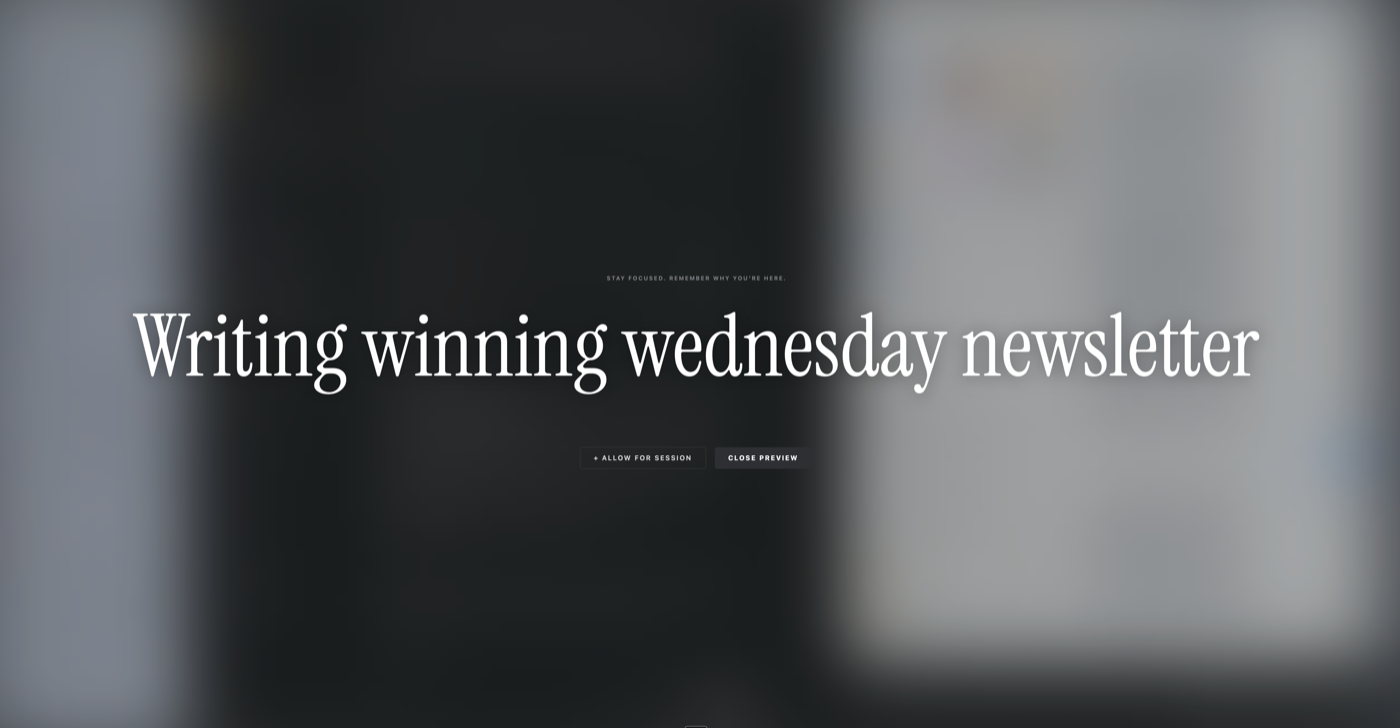
When I need to really lock in, I use Mission Mode. That screenshot above is from the day I wrote this. I set one task, one timer, and everything else got blocked at the OS level. It puts up a full-screen reminder of what I said I was doing.
AI plus an ADHD brain is a superpower, but only if you can focus long enough to use it. AI lets me make more. Helm gives me the container to use it.
If you're on a Mac: try Helm for Mac. Looking for it on Windows? Join the Helm for Windows waitlist.
🎥 ADHD resources worth your lunch break
Jessica McCabe's TEDx talk, Failing at Normal: An ADHD Success Story, is 13 minutes. She nails what this post is about: ADHD is a different operating system. Watch this one over lunch.
AI Native, my free 7-day challenge, shows how I use AI day-to-day, for the business and for my ADHD brain. There's no pitch and nothing to buy at the end. I've really enjoyed sharing more of what I'm up to.
✍️ Reflection: when did you last forget to eat?
When was the last time you were so absorbed in something you forgot to eat? What were you doing, and what made that possible?
If you get Winning Wednesday, hit reply and tell me. I read every one.
Talk soon,
Cathryn