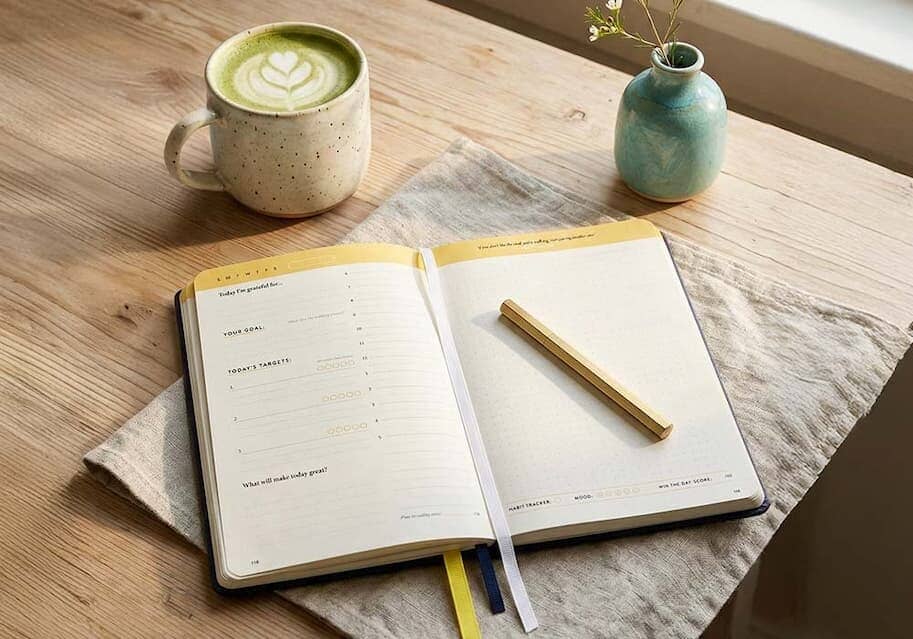
I started a new journal this week.
I brought one to San Francisco. Then I lost it. 🫠
This should be an awkward admission from someone who makes journals. But I've gotten to know some of you through Winning Wednesday over the years, and I suspect I'm in good company.
For two and a half months after we moved the family to San Francisco on three weeks' notice, life ran at startup speed. Some days were such a whirlwind that I genuinely couldn't remember what I'd done.
The funny part is that I designed the Self Journal before I knew I had ADHD.
🧠 Diagnosed with ADHD at 31, years after I built the journal
I was diagnosed at 31. A few friends had mentioned getting diagnosed, and one finally asked if I'd ever been checked.
"I've been wanting to ask you for a while."
By then, hundreds of customers with ADHD had already written to tell us how well the journal worked for them.
I had built the product and read the emails. I still hadn't connected any of it to myself. The signs went back to school, like the locker key I kept losing and the textbooks I carried everywhere.
📓 Consistency without rigidity: why the Self Journal is undated
The Self Journal came out of years of trying planners that never worked for me. I always felt like I was running to keep up.
At the time, I couldn't name what I was designing around. I just knew I didn't want a planner that decided when I was allowed to begin.
If I was ready to start on September 20, I didn't want to wait until January 1.
I also didn't want one missed week to turn the rest of the book into a record of everything I had failed to do.
A blank notebook gives me too little structure. A rigid planner gives me too much. I wanted enough structure to make my priorities visible, with enough flexibility to survive a missed day or an entire season when life goes sideways.
If a system only works when I use it perfectly, I will eventually stop using it.
🗒️ Out of sight, out of mind: why my journal stays open on my desk
Out of sight, out of mind is annoyingly literal for me.
If the journal disappears into a drawer, the plan tends to disappear with it.
If it stays open on my desk, I can see where my time is going. When I write down what I'm about to do, I'm less likely to bounce into three other things before I finish it.
AI can hold more information than I could ever keep in my head. A notebook left open on my desk helps me decide what matters today.
I am obsessed with AI. I love learning and seeing how fast all of this can move.
But when I have spent too long inside it and start to feel slightly unhinged by the speed of everything, I go back to paper. I've written before about why I quit productivity apps and went back to paper.
Writing slows me down enough to notice what I am doing. It makes me feel human again.
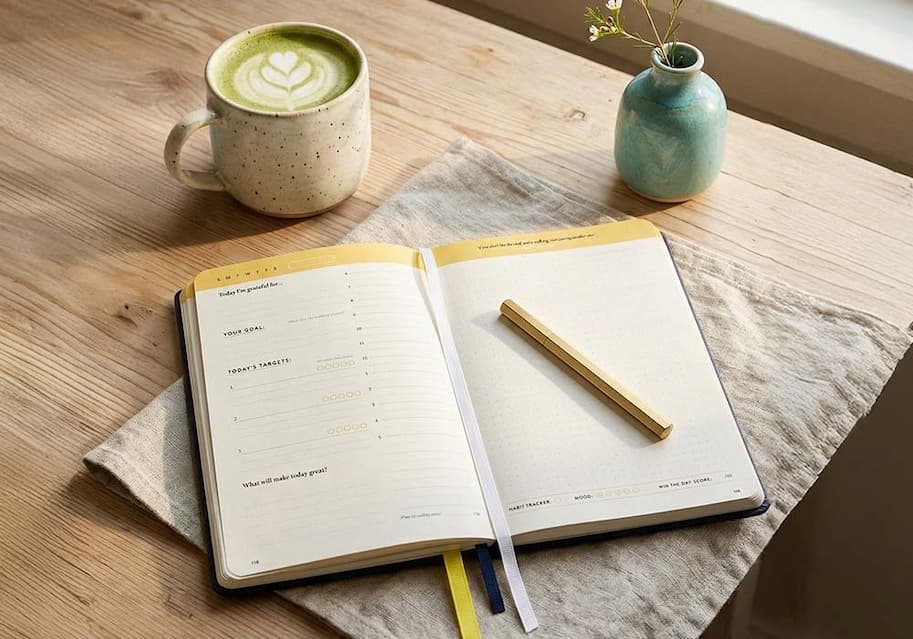
⏱️ Your Wednesday challenge: keep a 30-minute time log on paper
Grab a notebook or journal and put it on your desk. One of ours is lovely, obviously, but the half-used notebook you already own works too.
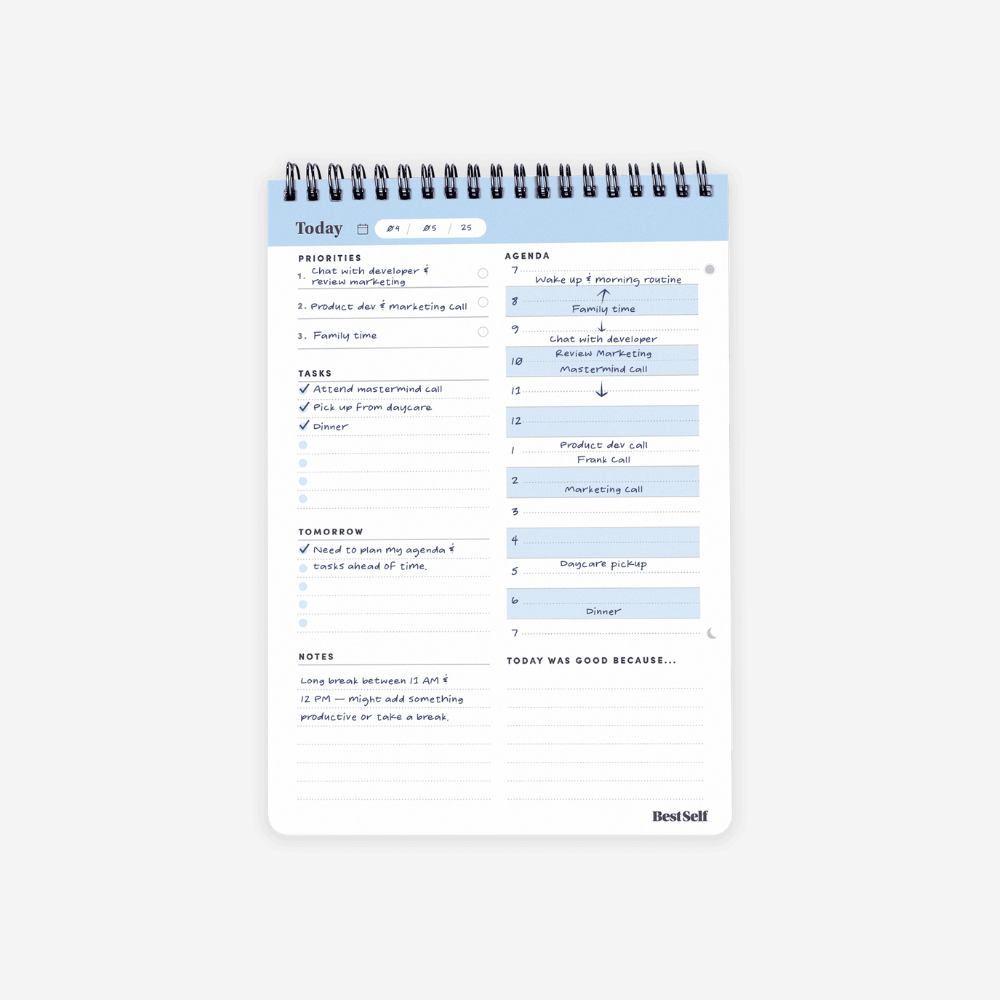
If you have a Daily Action Pad, this is exactly what it is good for.
Set a timer to go off every 30 minutes. When it goes off, write down what you spent the last half hour doing and what you are about to do next.
If you miss two alarms, pick it up at the next one. Do not backfill anything.
It's wild how the act of writing it down makes you more aware of where your time is going. The timer interrupts autopilot long enough for you to notice. It's the same reason journaling works when you can't solve everything in your head.
The Self Journal is undated for exactly this reason. We left the dates blank so you can start on September 20, or start again after disappearing for two and a half months.
🎧 Three interesting things: a podcast, a book about notebooks and an AI prompt
Listen: I talked with Michael Galpert on Already Here about how I went from non-developer to building agents, and why useful AI still needs humans in the loop.
Read: The Notebook: A History of Thinking on Paper by Roland Allen. It follows how people have used notebooks to think, from Leonardo da Vinci to Marie Curie. Given everything above, it felt almost suspiciously on-topic.
A prompt to try: take a photo of your time log at the end of the day and ask AI: "Look at this page. Where did I switch context most? What kept pulling me away? Give me one specific change to try tomorrow, not a new productivity system." Leave anything private out of the photo.
Talk soon,
Cathryn
P.S. What helps you stay consistent without making you feel trapped? If you get Winning Wednesday, hit reply and tell me.