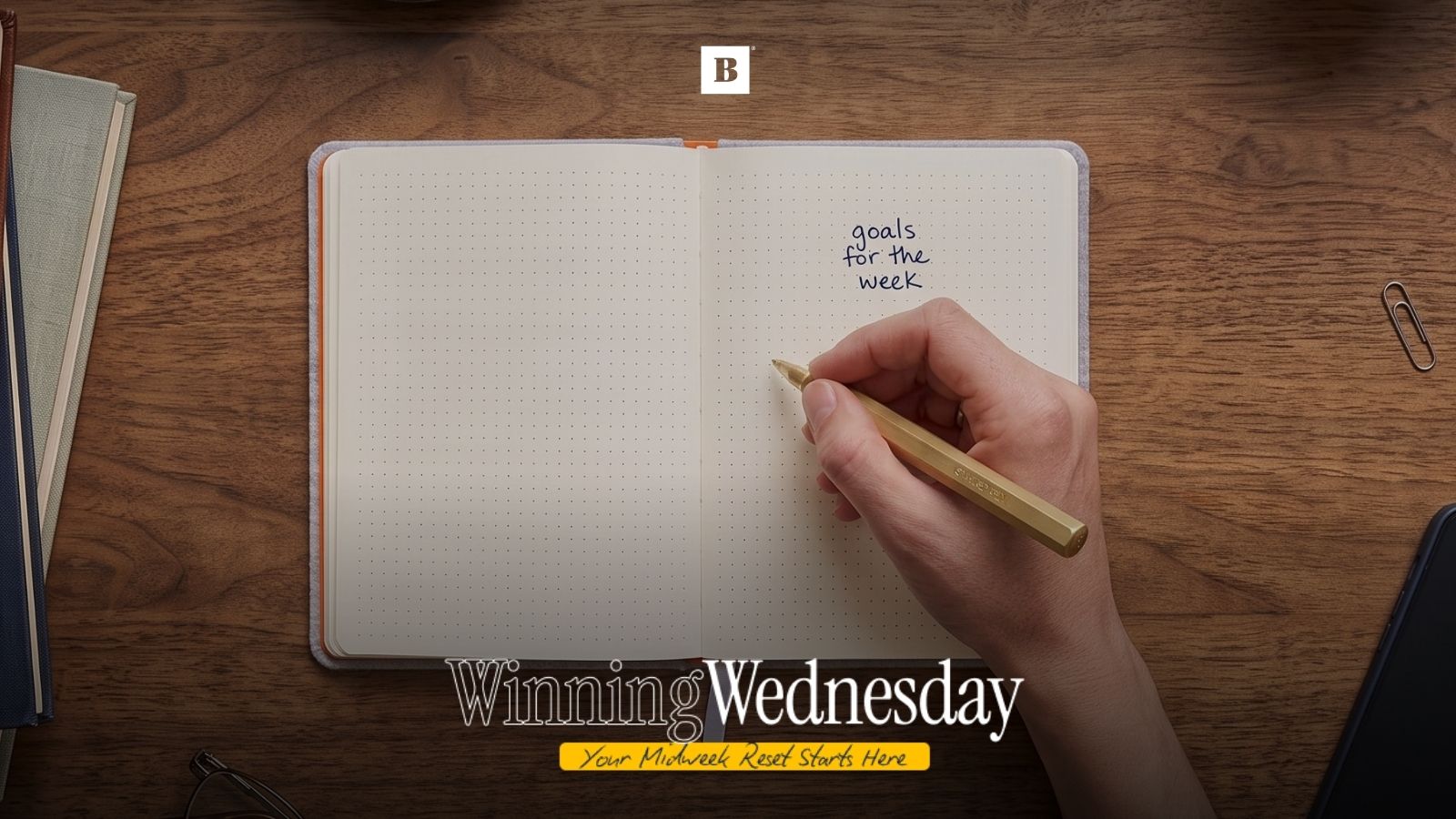

You Can't Solve This in Your Head
For years, I wrote 750 words by hand every morning before I did anything else.
It started after reading The Artist's Way and what Julia Cameron called morning pages. The rule was almost embarrassingly simple: pick up a pen, fill the pages, do not stop. Not "write well." Not "have something to say." Just don't stop.
That practice taught me something I didn't expect.
You don't actually know what's in your head until you put it on the page. The thought you thought you were having is usually three layers above the one you're actually having.
I was 30 the first time it really paid off.
I was working through a journaling exercise after a seminar, nothing dramatic, when a pattern that had been quietly running my life for almost three decades fell out onto the page. It traced back to a story I had told myself after a 30-second event from when I was three years old.
Three.
I had carried that story around long enough to have built choices, relationships, and an entire career on top of it, and I had never seen it. Not until I wrote.
That's the part of writing I think we keep underestimating, especially now, in a world where AI can finish the sentence for us before we've even finished the thought.
The point of writing isn't the output. The point is to see what was already in there. The process is how we filter out what's actually going on.
These are the blind spots we can't see from inside our own head. Writing is one of the only tools I know that puts them in front of you.
Why Writing Works
Here's the part that has held up across decades of research.
When you write by hand, more of your brain lights up than when you type. EEG studies show longhand activates the regions involved in memory, comprehension, and meaning-making in ways that keyboarding does not. Short, regular sessions of expressive writing have been linked to measurable improvements in stress, sleep, and even immune markers (wild!). The benefits show up whether or not anyone ever reads what you wrote.
And then there's the Zeigarnik effect. Your brain refuses to drop an unfinished thought until it's been resolved or written down with a concrete next step. That's the 2 am loop. That's the conversation you keep rehearsing. Your brain isn't broken. It's doing exactly what it's supposed to do with a problem that has no landing pad.
The thoughts you cannot put down are not too important to write. They are too complex to keep in your head.
There's a simpler version of this rule that you already follow without thinking about it.
You can do 5 + 3 in your head. You can probably do 12 x 12 in your head if you have to.
But nobody divides 202,542 by 186 by staring at the ceiling. You reach for paper or, let's be honest, a calculator. You don't argue with yourself about it. You just know that math at that size doesn't belong in your head.
Somehow we forget this the second the equation stops being numbers.
The decision you've been circling for weeks. The conversation you keep rehearsing. The goal that's been "in progress" for six months. The feeling you can't quite name.
We try to solve all of it inside our heads and then wonder why we feel scattered.
The Two-Week Writing Reset
This is what I want you to try for the next 14 days.
One page. Once a day. By hand. No rules.
- No format. Lists, arrows, half-sentences, doodles, crossed-out lines that turn into one clear sentence at the bottom. All of it counts.
- Name one loop. What is the thing your brain keeps replaying? Put it on the page in any form, even ugly.
- One next step. End each page with one concrete thing you could do in the next 24 hours.
Five to fifteen minutes. Pen and paper, not phone.
The goal isn't to write something good. The goal is to stop trying to solve the equation in your head.
You'll notice something within a few days. The loops that felt huge while they were trapped in your brain shrink the second you make them visible. Some turn out to be one decision in disguise. Some turn out to be a question you have been avoiding asking. Some get smaller just because they stop competing for space with everything else.
You cannot edit a thought you cannot see.

Before bed tonight, open a blank page and answer three questions by hand:
1. What am I trying to solve in my head right now?
2. Which part is fact, and which part is the story I'm telling myself about it?
3. What is one next step I can take in the next 24 hours?
Then do it again tomorrow. And the next day. Fourteen days total.
Make it easier: If a full page feels like too much, set a 5-minute timer and stop when it goes off. Five minutes count. Stopping mid-sentence counts.

What decision would get easier if you stopped thinking about it and started writing it down?

📚 Read: The Artist's Way by Julia Cameron. The original case for morning pages. Three pages, by hand, every morning, no editing. The book is older than most of the productivity advice on the internet, and it still holds up.
🧠 Research note: Look up Mueller and Oppenheimer's "The Pen Is Mightier Than the Keyboard" and James Pennebaker's expressive writing studies. Different angles, same finding: writing by hand changes what your brain does with the thought.
🔍 Try this: Leave a notebook open on the desk you use most, with a pen resting on top of it. The friction to start drops to zero. The notebook doesn't need to be nice. It just needs to be visible.
If your week has felt mentally noisy, this is your sign to give your thoughts somewhere to land that isn't between your ears.
You don't need better thoughts. You need a page.