Vision boards have a reputation problem. They're either dismissed as magical thinking or embraced without any connection to action. The truth's somewhere in the middle: visualization is a legitimate psychological tool, but only when paired with strategy and effort.
This guide isn't about manifesting your dreams through positive thinking alone. It's about using visualization as one component of goal achievement, backed by research on how mental rehearsal affects performance and motivation.
Done right, a vision board clarifies what you want, keeps your goals visible, and primes your brain to notice opportunities aligned with your vision. Done wrong, it becomes pretty wall art that makes you feel good without changing anything.
Here's how to do it right.
Does visualization actually work? The science
Research on visualization is nuanced. The findings don't support passive daydreaming, but they do support active mental rehearsal.
Athletes have used visualization for decades because it works. Studies show that mental rehearsal activates similar neural pathways as physical practice. Imagining yourself performing a skill improves your ability to perform it.
But here's the catch: research by Gabriele Oettingen shows that fantasizing about positive outcomes without considering obstacles decreases motivation. People who vividly imagine success feel satisfied in the moment and expend less effort pursuing the goal.
The solution isn't to abandon visualization, it's to combine it with implementation planning. Oettingen's "mental contrasting" technique pairs positive visualization with realistic obstacle anticipation. You imagine the goal, then imagine what might get in the way, then plan for those obstacles.
A vision board can be part of this process. It's a tool for clarity and motivation, not a substitute for action.
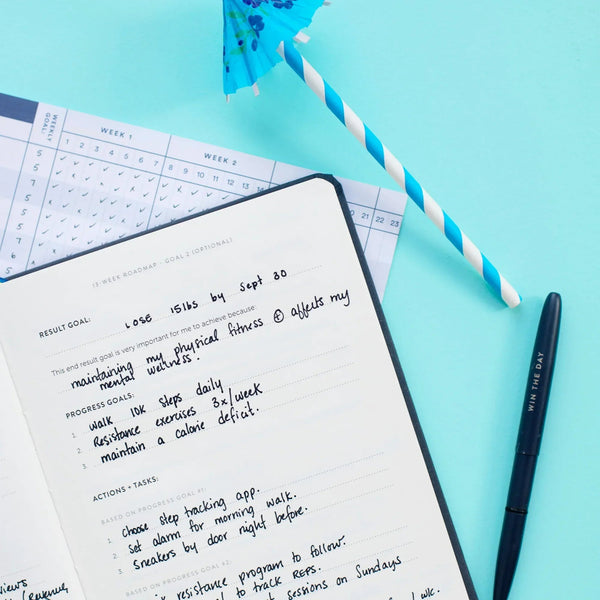
Pair your vision board with daily action steps using the Self Journal. Visualization works best when combined with structured goal pursuit.
What to include on your vision board
Effective vision boards go beyond pretty pictures. They incorporate multiple elements:
Specific goals. Not vague wishes but concrete outcomes. "Run a marathon" instead of "get fit." "$150,000 annual income" instead of "make more money." Specificity directs attention and enables progress tracking.
Feelings you want to experience. What emotional states are you pursuing? Freedom? Security? Adventure? Peace? Sometimes the goal itself matters less than how you want to feel. Include words or images that evoke those feelings.
Values you want to embody. What person do you want to be? What principles guide your decisions? Values like integrity, creativity, connection, or growth can anchor your board in who you are, not external achievements.
Actions and habits. What daily behaviors lead to your goals? Include reminders of the person you're becoming through your actions, not destinations alone.
What to avoid:
- Vague wishes without specificity ("more happiness")
- Someone else's goals that don't resonate with you
- Images chosen for aesthetics without personal meaning
- Excessive material focus without emotional or relational goals
Vision board ideas by life area
These prompts help you identify what to include in each domain of your life.
Career and professional goals
What does your ideal work life look like?
- The role itself. What job title, responsibilities, or type of work do you want?
- Work environment. Office, remote, hybrid? What does your workspace look like?
- Income. Be specific. What salary or revenue do you want to earn?
- Impact. What difference do you want to make through your work?
- Skills. What abilities do you want to develop or master?
- Recognition. What achievements or acknowledgments matter to you?
- Work-life integration. How does work fit into your broader life?
Example images: your dream office, companies you admire, credentials you're pursuing, representations of your ideal workday.
Health and wellness
What does thriving physically and mentally look like for you?
- Fitness. Specific goals like running a 5K, doing 10 pull-ups, or practicing yoga three times weekly.
- Energy. How do you want to feel in your body? Alert? Strong? Relaxed?
- Habits. What daily practices support your health? Morning exercise, meal prep, sleep routine?
- Mental health. What does emotional wellbeing look like? Therapy, meditation, boundaries?
- Body relationship. How do you want to feel about your body, regardless of its size or shape?
Example images: activities you want to do, foods that nourish you, places you'll go when you feel strong, representations of the energy you want.
Relationships
What kinds of connections do you want in your life?
- Romantic partnership. Qualities of the relationship you want (existing or future).
- Friendships. Depth, frequency, types of activities with friends.
- Family. How you want to show up for family, what you want to build together.
- Community. Groups, causes, or communities you want to belong to.
- Social life. How often you want to connect, what your ideal social calendar looks like.
Example images: representations of quality time, activities you'd do with loved ones, symbols of the connection you seek.
For relationship goal ideas, see our couples bucket list.
Personal growth
Who are you becoming?
- Learning. What do you want to study, read, or master?
- Experiences. What do you want to try? Travel, hobbies, adventures?
- Fears to overcome. What would you do if you weren't afraid?
- Mindset shifts. What beliefs do you want to change or strengthen?
- Character development. What qualities do you want to cultivate?
Example images: books you want to read, skills you want to learn, representations of the person you're becoming.
Financial goals
What does financial security and freedom look like?
- Income. Specific numbers for salary, revenue, or passive income.
- Savings. Emergency fund, retirement, specific savings goals.
- Debt freedom. Payoff targets and timelines.
- Investments. Portfolio goals, property, business ownership.
- What money enables. Experiences, security, generosity, freedom.
Example images: visual representations of financial goals (not stacks of cash, but what money enables: the house, the travel, the freedom).
Lifestyle and environment
How do you want to live day to day?
- Home. What does your ideal living space look like? Location, style, feeling?
- Daily life. How do you want your typical day to feel and flow?
- Travel. Places you want to visit, how often, what kind of travel?
- Possessions. Items that actually add something to your life, not just stuff (be thoughtful here).
- Aesthetics. The visual style and environment that brings you joy.
Example images: dream home elements, travel destinations, daily routines you aspire to.
Step-by-step: how to make your vision board
Step 1: Gather materials
For physical boards:
- Poster board, cork board, or foam board
- Magazines, printed images, or personal photos
- Scissors, glue or tape
- Markers, stickers, or other decorative elements
For digital boards:
- Canva (free templates available)
- Pinterest (private board)
- Notion, Milanote, or similar tools
- Phone wallpaper apps
Step 2: Reflect on your goals
Before gathering images, get clear on what you want. Journaling prompts to consider:
- What would make this year a success?
- How do I want to feel in six months? A year? Five years?
- What would I do if I knew I couldn't fail?
- What am I tolerating that I want to change?
- What brings me the most joy and fulfillment?
Spend at least 30 minutes on this reflection. Clarity before creation prevents a board full of things that don't matter to you.
Step 3: Find images and words
Search for visuals that resonate emotionally, not aesthetically. The right image makes you feel something when you look at it. It connects to your specific goals, not generic aspirations.
Sources:
- Magazines (lifestyle, travel, business, wellness)
- Pinterest or Google Images (print what resonates)
- Personal photos from meaningful moments
- Quotes or affirmations that inspire you
Step 4: Arrange intentionally
Some people organize by life area. Others place the most important goals in the center. Some prefer collage chaos. There's no wrong approach, but be intentional.
Consider:
- What deserves the most prominent placement?
- How do different goals relate to each other?
- Is there a theme or feeling you want the whole board to convey?
Step 5: Add affirmations or mantras
Words reinforce images. Include phrases like:
- "I am capable of achieving this"
- "Every day I move closer to my goals"
- Specific affirmations for your particular challenges
For affirmation inspiration, explore our confidence quotes.
Step 6: Display where you'll see it daily
A vision board in a drawer doesn't work. Place it where you'll encounter it regularly:
- Above your desk
- On your bedroom wall
- As your phone or computer wallpaper
- In your daily planner
Digital vs. physical vision boards
Physical board advantages:
- Tactile creation process enhances engagement
- More visible and harder to ignore
- Doesn't require technology
- Can be collaborative (create with a partner or friend)
Physical board drawbacks:
- Takes up space
- Harder to update
- Limited to available images
Digital board advantages:
- Unlimited image access
- Easy to update and revise
- Portable (phone wallpaper, tablet)
- Can incorporate videos or links
Digital board drawbacks:
- Easier to ignore among digital noise
- Creation process less immersive
- Screen fatigue
Hybrid approach: create a physical board for the process and daily visibility, plus a digital version for your devices.
How to actually use your vision board
Creating the board is step one. Using it is where results happen.
Daily visualization practice (five minutes):
- Look at your board each morning
- Don't just passively observe. Actively imagine yourself achieving each goal
- Notice how it feels to have what you want
- Let that feeling motivate your day
Connect to action:
- What can you do today that moves you toward something on your board?
- Use daily and weekly planning to translate vision into tasks
- The Self Journal helps bridge vision to daily action
Regular review:
- Weekly: is your current focus aligned with your board?
- Monthly: what progress have you made? What needs more attention?
- Quarterly: does your board still represent what you want?
Vision board mistakes to avoid
Too vague. "Happiness" isn't actionable. What specific outcomes would make you happy? Specificity enables progress.
No emotional connection. A board of generic luxury images won't motivate you if those things don't matter to you. Include only what resonates.
Made it, forgot it. A vision board gathering dust doesn't work. If you won't look at it daily, reconsider placement or format.
All dreams, no action. Vision boards support goal achievement, they don't replace it. Without corresponding effort, they're decoration.
Someone else's goals. Be honest about whether your board reflects your desires or external expectations. Pursuing goals that don't resonate leads to hollow achievement.
When to update your vision board
Vision boards aren't permanent. Life changes. You change. Review and revise:
Quarterly. Check alignment. Has anything shifted? Do you need to add, remove, or modify?
After major life changes. New job, relationship changes, moves, health shifts. Update your board to reflect your current reality and desires.
When goals are achieved. Celebrate. Then decide what comes next. Replace achieved goals with new ones.
When goals change. That's allowed. Removing something from your board isn't failure. It's clarity.
Your vision deserves a plan
A vision board shows you where you want to go. A plan gets you there.
The most effective approach combines visualization with structured goal pursuit: big-picture vision translated into quarterly goals, broken into monthly milestones, executed through weekly and daily actions.
Your vision board is the why. Your planning system is the how.
Start with the Self Journal, designed for 13-week goal cycles that turn visions into reality.
Frequently asked questions
Do vision boards work?
Visualization alone doesn't achieve goals. But combined with specific goal-setting, planning, and action, vision boards can clarify priorities, maintain motivation, and keep goals visible. They're one tool in a larger system, not magic.
What should I not put on my vision board?
Avoid vague concepts without specific meaning, goals that aren't yours (external expectations), excessive material focus without deeper values, and anything you include for aesthetics rather than genuine resonance.
How often should I look at my vision board?
Daily is ideal. A quick morning review (2-5 minutes) primes your brain to notice opportunities aligned with your goals. If it's not visible daily, consider changing its location.
Can couples create a vision board together?
Absolutely. Shared vision boards can align partners on future goals, facilitate important conversations, and create excitement about what you're building together.
Should my vision board be private or public?
Personal preference. Some people find accountability in sharing; others find it drains motivation. Research suggests that announcing goals can sometimes satisfy the need for achievement without doing the work. Consider keeping yours private or sharing selectively.
When is the best time to create a vision board?
New Year is popular but not required. Any transition point works: new quarter, birthday, job change, or when you're ready to get clear on what you want. The best time is when you'll engage with the process thoughtfully.