There’s a story most fathers tell themselves, quietly, somewhere in the middle of all of it.
That fatherhood is a giving thing. That the best version of being a dad means putting yourself second — your time, your ambitions, your needs — because that’s what it costs to do it right. That showing up for them is a sacrifice, and a worthwhile one, but a sacrifice nonetheless.
The research says something different. And it’s worth knowing.
What the data actually found
In a 2013 study published in Fathering, Letitia E. Kotila and Claire M. Kamp Dush examined the relationship between fathers’ involvement with their children and fathers’ psychological well-being. Their findings challenged the simplest version of the sacrifice narrative: active involvement was associated with fathers’ own well-being, not just their children’s outcomes.
Not their kids’ wellbeing. Theirs.
The relationship was more complicated than a one-way gift from father to child. Showing up for his children was not only something he gave away. It could also reinforce something in him — a sense of mattering, of being necessary in a specific and irreplaceable way, of having work that compounds over time rather than resets every Monday morning.
This doesn’t mean fatherhood isn’t hard. It means the hardness isn’t the whole story.
Why most dads miss this
The culture of fatherhood is built almost entirely around output. What he provides. What he teaches. What he sacrifices. What he builds for them. The conversation is always directed outward — toward the kids, toward the family, toward what they need from him.
Nobody tells him what he gets back.
And because nobody tells him, he doesn’t look for it. He grinds through the exhaustion and the calendar and the feeling of being needed by everyone simultaneously, and he calls it love, and it is love, but he doesn’t know that it’s also — quietly, measurably — making him more of himself.
The fathers who seem to age well, who carry a certain groundedness into their fifties and sixties that’s hard to name but easy to recognize — they’re often the ones who stayed engaged. Not perfectly. Not without complaint. Just consistently present in the lives of their kids in a way that kept asking something real of them.
That asking is the thing. It keeps him in the game with himself.
The part that compounds
The Schindler findings make more sense when you look at what engagement actually requires of a father.
To be present with a child — genuinely present, not just physically in the room — you have to slow down. You have to listen to questions that seem small but aren’t. You have to access a kind of patience and attention that most of adult professional life doesn’t ask for. You have to be curious about someone else’s inner world instead of managing your own.
Those aren’t just parenting skills. They’re human skills. And practicing them, repeatedly, in the context of a relationship that matters enormously to you — that’s not a drain. That’s a discipline.
The father who puts his phone down and actually plays. The father who asks a question and waits for the real answer. The father who shows up to the ordinary Tuesday with something like intention — he’s not just giving his kids something. He’s building something in himself that shows up everywhere else too.
It compounds. That’s the word for it.
What this means for Father’s Day
Most Father’s Day gifts are thank-yous. Which is right — he deserves to be thanked. But the most useful thing you can give a father isn’t appreciation for what he’s already done. It’s a tool that helps him keep doing it, and helps him do it better.
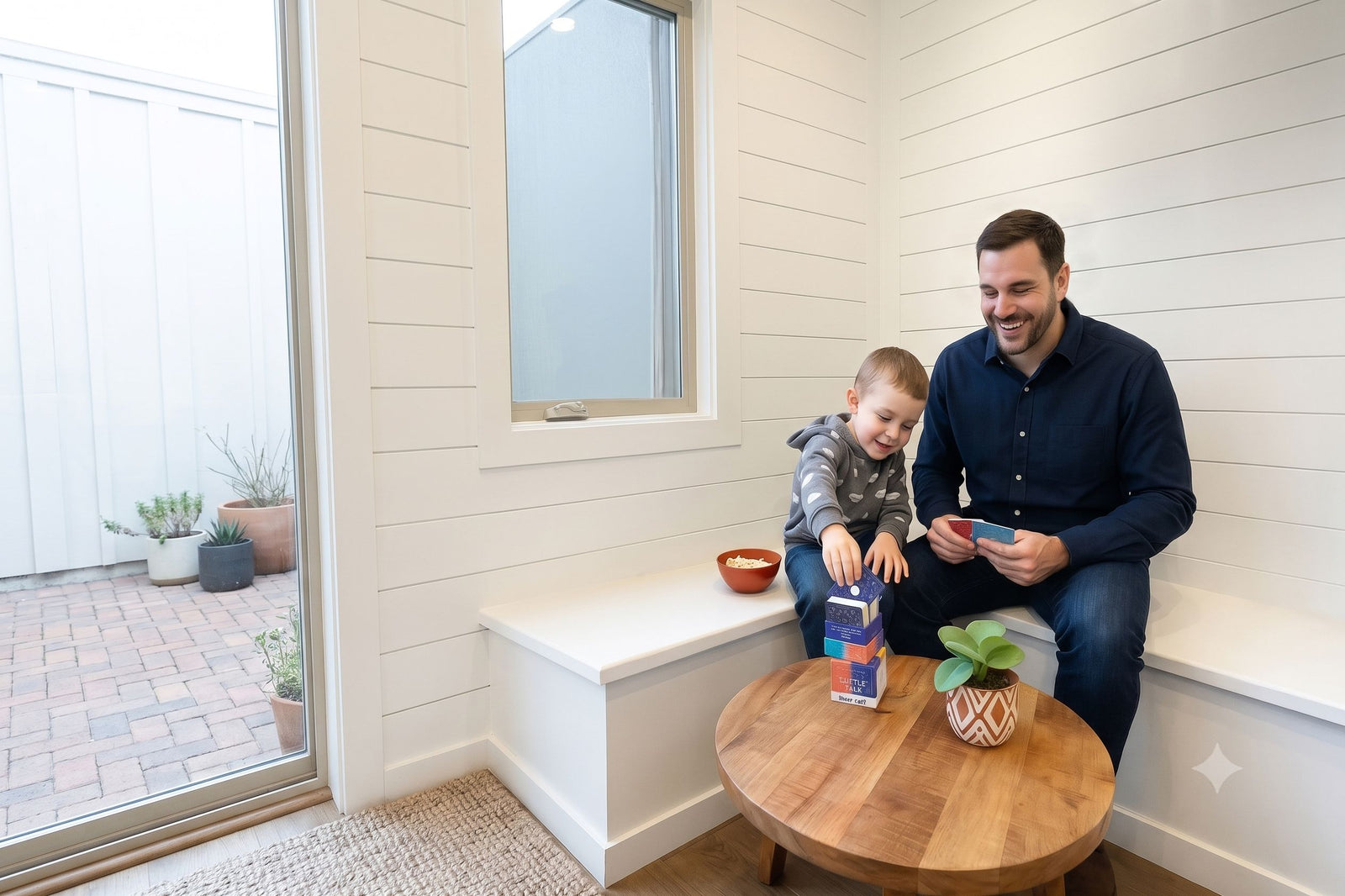
A journal that gives him fifteen minutes in the morning that belong only to him — where he can think clearly before the day starts asking. A card deck that makes the conversations with his kids easier to start and harder to end. A focus device that makes his phone less present so he can be more present.
Not because he needs fixing. Because he’s already in the middle of something important, and the right tools make important things easier to sustain.
The Self Journal is built for the dad who’s still working on his goals alongside everything else. The Little Talk Deck is built for the dad who wants the conversations with his kids to go somewhere real. The Helm is for the dad who knows his phone is the one thing standing between him and the presence he’s trying to give.
Showing up for them isn’t the sacrifice. It’s the investment in them and in himself, at the same time.
That’s not a greeting card sentiment. That’s what the data says.
Shop the Father’s Day collection →
Tools for the dad who’s still becoming — because that’s the whole point.
Sources for Blog Post 4
Kotila, L. E., & Kamp Dush, C. M. (2013). “Involvement with Children and Low-Income Fathers’ Psychological Well-Being.” Fathering. Read the study →