If you are wondering whether screen time is actually a problem for babies—or whether this is another parenting issue inflated by the internet—you are not alone.
The short answer is that most experts recommend avoiding or sharply limiting screen media for babies under 2, with video calls as the main exception.
That guidance is not based on moral panic. It comes from what researchers know about how babies learn, how early brain development works, and what screens tend to replace.
What experts recommend
American Academy of Pediatrics (AAP)
The AAP recommends:
- under 18 months: avoid screen media other than video chatting
- 18-24 months: if you introduce digital media, choose high-quality content and watch it together
- ages 2-5: keep screen time limited and focus on high-quality programming
World Health Organization (WHO)
The WHO guidance is similarly strict for very young children:
- under 1 year: no sedentary screen time
- ages 1-2: avoid sedentary screen time as much as possible; less is better
These recommendations may sound intense, but they make more sense once you look at how babies actually learn.
Why screen time is not very useful for babies
The main issue is not that screens are uniquely toxic. It is that they do not provide what babies need most.
Babies learn best through:
- face-to-face interaction
- responsive language
- touch and movement
- real-world exploration
- repetition with human feedback
Screens do not do those things well.
The video deficit effect
One of the most important ideas in this conversation is something researchers call the video deficit effect.
Babies and very young toddlers learn far less from a video demonstration than from a live, in-person one—even when the content is basically identical.
That matters because a lot of baby-targeted screen content is marketed as educational. But for babies, the medium itself is a problem.
They are not just absorbing information. They are learning through interaction.
Why interaction matters so much
Babies build language, emotional regulation, and early understanding through back-and-forth exchange.
That includes things like:
- hearing your voice respond to them
- watching your face change expression
- babbling and getting a reaction
- hearing words connected to real objects and actions
- being physically engaged with the world around them
This is often called “serve and return” interaction. It is one of the key building blocks of early development.
A screen can show content, but it cannot truly participate in that exchange.
What screen time can displace
The biggest concern with baby screen time is often what it replaces.
When a baby is watching a screen, they are not doing other things that matter more developmentally, such as:
- hearing directed language from caregivers
- exploring objects with their hands
- moving their body freely
- practicing attention in the slower pace of real life
- engaging socially with the people around them
This is why researchers often focus on displacement rather than simple exposure.
What the research suggests
Research in this area is not perfect. A lot of it is correlational, which means it can show patterns without proving direct causation.
Still, several findings keep showing up:
- more screen exposure in very early childhood is associated with weaker language outcomes
- background TV reduces the amount and quality of parent-child interaction
- screen use before sleep is linked with shorter sleep duration and more disrupted sleep
- babies and toddlers learn much less effectively from video than from live interaction
That combination is enough to justify a cautious approach.
Is all screen time equally bad?
No, but for babies under 2, the range of genuinely helpful screen use is very small.
Video calls are different
Video calls are the main exception because they can be interactive. A grandparent who pauses, responds, smiles back, and engages with the baby is doing something much closer to real interaction than passive video watching.
Passive viewing is the bigger issue
TV shows, phone videos, and “educational” baby content are much less helpful because they do not respond to the child in real time.
What about educational baby apps and videos?
This is where a lot of parents get misled.
For babies under 2, there is little good evidence that “educational” screen content produces the kind of learning marketers often imply.
A baby may stare at a colorful video, but attention is not the same thing as understanding.
For this age group, talking, reading, singing, movement, and real-world play are still much more useful.
Better alternatives to screen time for babies
If you are trying to reduce screens, the most helpful question is usually: what can I do instead?
Newborn to 6 months
- talk, sing, and narrate your day
- tummy time
- black-and-white images
- looking at faces
- walks outside
- mirrors and simple visual stimulation
6 to 12 months
- object exploration
- peek-a-boo and simple social games
- board books
- music and dancing
- sensory play
- supervised outdoor time
12 to 24 months
- stacking and container play
- simple puzzles
- scribbling and art materials
- pretend play
- ball play and movement
- reading together
- naming objects and narrating everyday routines
These activities are less flashy than screens, but they are far better matched to how babies learn.
What if you have older kids too?
This is one of the hardest real-world situations.
A few practical ways to reduce baby exposure:
- keep background TV off when possible
- use headphones for older children using tablets
- keep the baby in a separate play area during sibling screen time
- line up older-kid screen time with naps when you can
- create one reliably screen-free zone for the baby
The goal is not perfection. It is reducing regular exposure in a busy real house.
If you have already used screens, do not panic
Parents do not need another reason to feel guilty.
What matters most is the overall pattern, not a few moments when you used a screen because you were exhausted, making dinner, or trying to get through the day.
If you want to change the pattern, you can start now. That matters more than obsessing over what already happened.
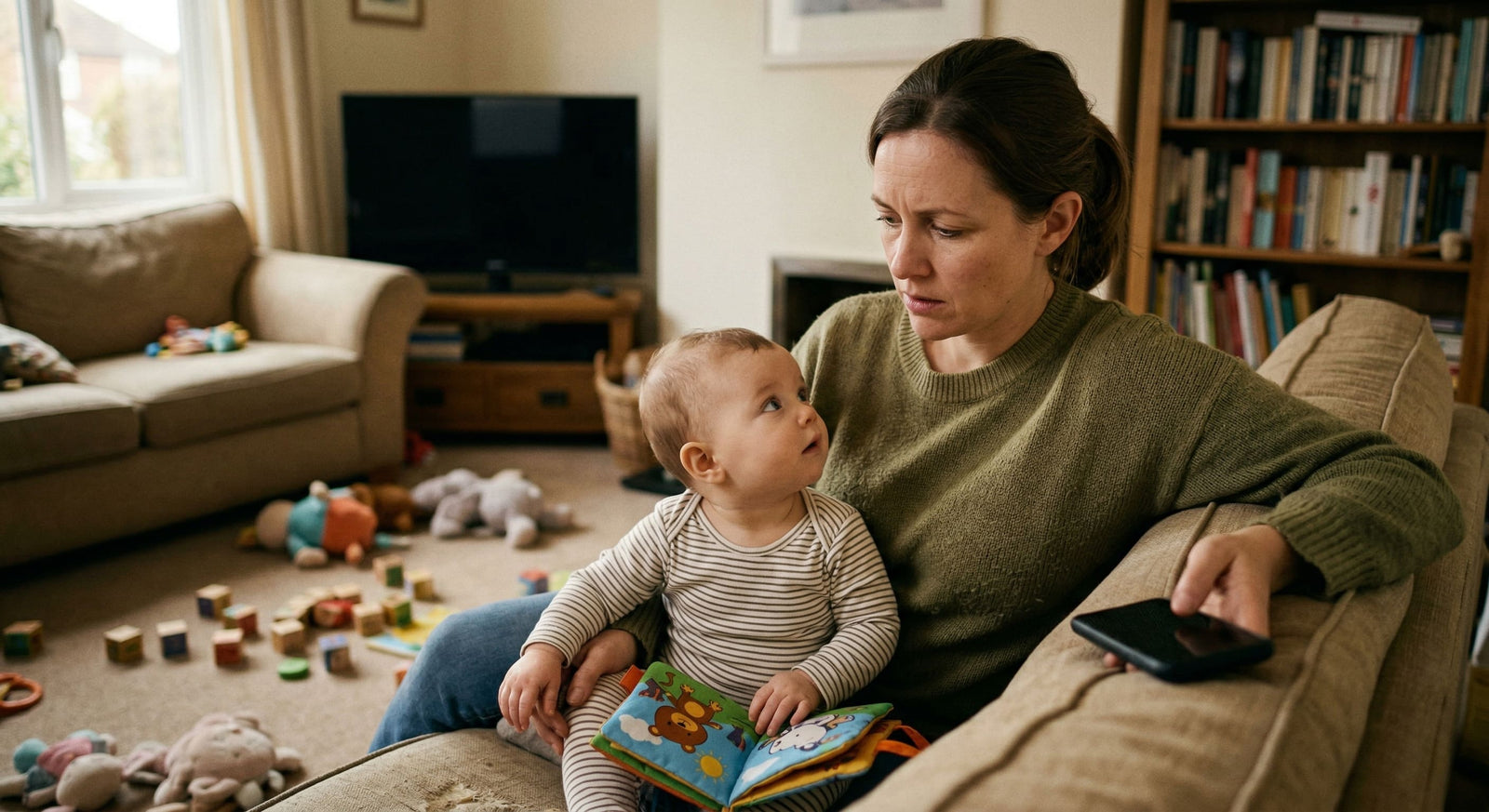
Your own phone use matters too
One of the most overlooked parts of this conversation is parent phone use.
If a caregiver is frequently distracted by a phone, babies may get:
- fewer words directed at them
- slower responses to cues
- less consistent eye contact and emotional feedback
No one needs to be perfectly present every second. But putting your own phone away during key interaction moments can make a real difference.
Frequently Asked Questions
Is screen time always harmful for babies?
Not every moment of exposure is harmful. The bigger issue is regular screen use replacing the kinds of interaction babies need most.
Are video calls okay?
Yes. Video calls are generally treated differently because they can be interactive and relational.
Will my baby fall behind without educational apps?
No. Babies do not need apps to learn well. They need responsive human interaction and real-world experience.
What if I need a break?
That is normal. Try lower-screen alternatives first when you can, but do not confuse “sometimes I need help” with failure.
When does screen time become more reasonable?
Most guidance starts opening up after 18-24 months, especially when content is high quality and used together with a caregiver.
The bottom line
Screen time is not the best tool for babies because babies learn best from people, not screens.
That is the core idea.
If you are trying to make better choices, you do not need perfection. You just need to keep pointing daily life toward the things babies benefit from most: interaction, language, play, movement, and real human presence.